Next stop is the Tobago Cays, five small island dots in a sea of turquoise, surrounded by shallow coral reefs. The area is a national park and is famed for its outstanding beauty and fantastic marine life (including turtles). We have a lovely sail down to the keys, top speed about 10 knots but happily sitting at about 8 knots for lots of the way. Flying fish jump across the bow, and boobies follow, duck diving to scoop up any fish they can catch near the surface.
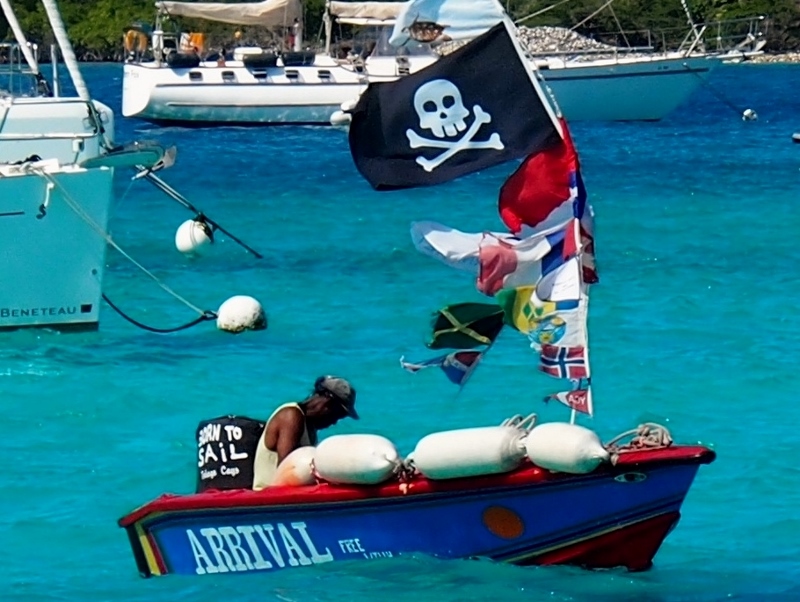
Once through the tricky pass to the entrance of the anchorage we are taken aback by the beauty of the place – turquoise water, white beaches, coconut palms, small vegetated islands, fringed by coral reefs. There are about 20 other boats in a small area of brilliant white sand and blue sea. We anchor, and are soon approached by boat boys. On offer are cigarettes, crayfish and croissants. Kind of strange to be offered croissants on an anchorage in the middle of nowhere, but we’re getting used to it. Where there is a need, there will be a service, and obviously there are enough boat traffic to make it worthwhile. It never ceases to amaze me how we human beings are so opportunistic, so good at making a living out of whatever is on offer.
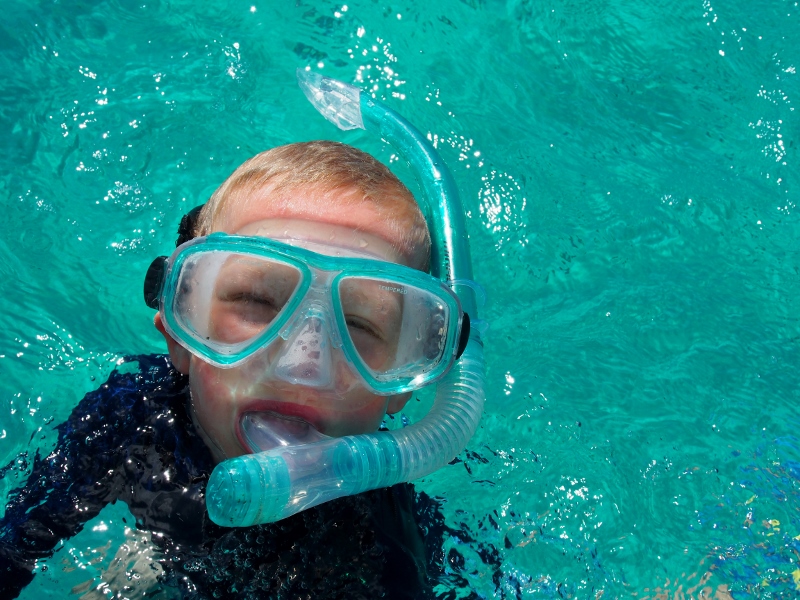
We snorkel lots, and on the sandy bottom beneath the boat we see sea urchins and small trunkfish, the latter coming up to take a nibble of our fins with their exquisite little kissy mouths. Lukie and I see a beautiful hawksbill turtle, gliding slowly through the water. Lukas is a sea of bubbles enthusiastically pursuing the turtle – he snorkels using both arms and legs and is faster than he is graceful. The turtle throws us a backwards glance, gently kicks its legs and is off.

Lukas is getting really good at snorkelling, often the first thing they do in the morning is jump in the water, and on this trip he’s easily spent two or more hours in the water per day. He is practicing duck diving, not easy when you are still a pudgy pre-schooler, and he bobs quickly up to the surface like a cork. When he surfaces, he says to me in wonder ‘Mummy, when I dive down, my snorkel fills with water?’, obviously still not quite grasping the technical bits of snorkelling. But he’s unfazed by not being able to breathe periodically, he just grabs hold of me (I’m always near) and tries to climb on top of me, kicking his little legs and gasping for air. When he gets tired, he asks for a lift, clinging to my back like the shell of a turtle as I kick us forward. Being Lukie, the fact that he is submerged doesn’t stop him from talking, and he emits constant enthusiastic commentary on whatever we see plus whatever else goes through his mind. I’ve always enjoyed the peace of diving and snorkelling; alas that peace is gone now.
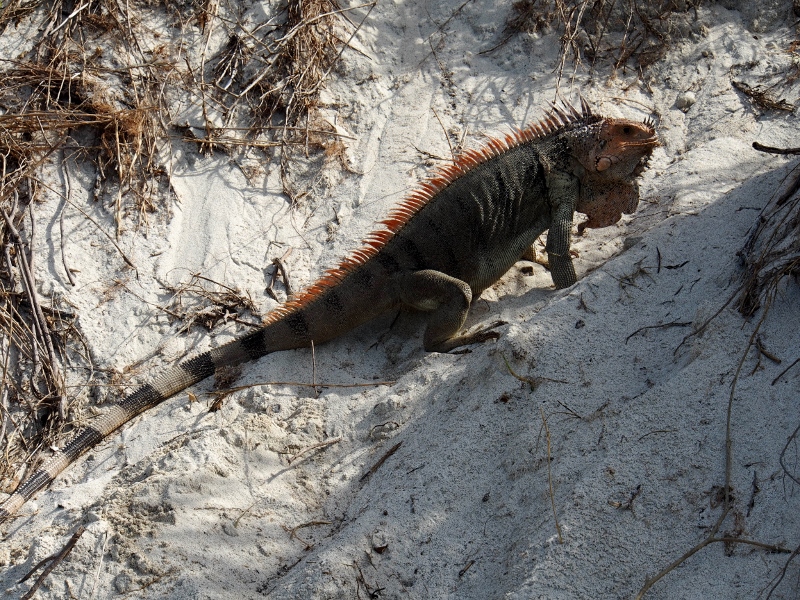
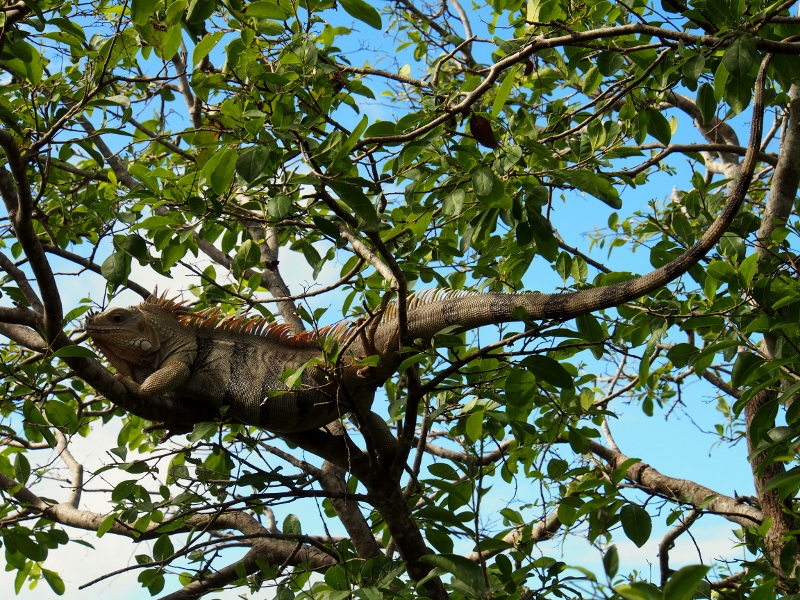
We explore the small uninhabited islands near the reef, climbing the hill behind the sand dune, arid soil covered in cacti, windswept trees and succulents. The islands’ main inhabitants seem to be huge iguanas, easily a metre long. They are everywhere, soaking in the early morning sun in the sand dunes, on the dusty path, in the undergrowth, perched at the end of a branch. We watch them slowly climb the trees, measuredly jumping from one branch to the next, the foliage dipping under their weights. Other inhabitants are beautifully rounded yellow-footed tortoises, the largest over a foot long, which wade slowly through the bush stopping periodically to gaze around them and eat what looks like rotten leaves. There are also large hermit crabs everywhere, scuttling away in their borrowed shells as we approach.
One evening we go ashore to where the locals cook lobster for guests from the visiting yachts. The boys are fascinated to watch the young men grab the lobsters by their antennae, hold them firmly and then swiftly chop them in half. The lobsters continue to twitch a long time after being halved, the legs frantically moving as if they were still hoping to flee.

Seated at a wooden table, with plastic plates, we are served the most amazing lobster dinner. Four half lobsters, fried plantain, barbecued potatoes, carrots and some other unidentifiable root vegetable, and lots of rice. Matias is squeamish about eating the lobster but Lukie digs in, quickly finishing half a lobster and eagerly asking for the other half. We end up breaking open every leg to pry out more juicy meat with Lukie hungrily watching, asking for more. After dinner, the boys are off spotting crabs with headtorches with their new friend Peter, a Polish boy we met.

George, A.K.A. Mr Fabulous is the guy who originally thought of the concept of cooking crayfish for tourists. He explains how it took him four years to develop from idea into a business. Initially, yachties were sceptical and unwilling to come ashore for a meal and he used to have to offer to cook the meal for free, giving the recipients the option to pay if they felt it was worth it. They obviously did, word spread, and now they are busy. But he is still struggling, mainly with the lack of local organisation and the way the rangers of the national park don’t have the interests of the environment or the local people at heart.

He would like to see the area better patrolled by rangers, fining people who rubbish and reprimanding people who don’t follow park rules. He wants to start a lobster seeding facility, replenishing the local reefs with lobsters. Most of all, he wants the environment properly protected, with locals able to make a living from the tourist that flock to visit the Cays.
It is tricky. Each ‘operator’, the guy in the boat who approaches the yachts, employs at least five people to catch and cook the lobsters. There are a total of 30 operators and so about 150 locals living off the lobster beach dining experience. Some of the guys are great, knowledgeable about the area and its history and keen to protect the amazing resource just beyond their doorstep. Others are in the business for a quick buck, and are happy to look the other way if boats anchor on the seagrass, or if local fishermen stray into the park to fish. Although a different area, it seems to me that the issues are not so very different from those back home in New Zealand, the eternal conflict between people needing to make a living and the preservation of the environment upon which that living is based. I agree with Mr Fabulous that ultimately the most important thing here in the Cays is to protect the outstanding environment, because all the local businesses revolve around the tourists that the area attracts. But I wonder with him about the effect of all the people – the coral reef is already showing signs of wear and tear, it is overgrown with algae in places, possibly a result of the high density of boats that occupy the area in the season, all releasing nutrients.

We feel privileged to visit, to swim with the turtles and rays, to show the children this wonderful environment of iguanas and tortoises. But we know that ultimately too many well meaning visitors like ourselves can easily wreck the place if it is not soon better policed.
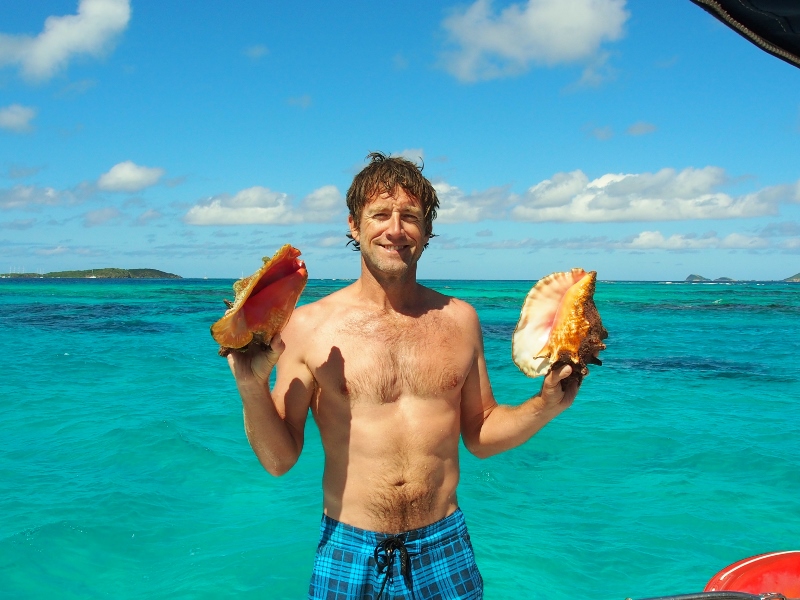
As a final farewell to the area, we sail to the ‘End of the World Reef’ beyond the keys – an amazing coral plateau at the edge of the Atlantic. We snorkel and catch Conch, and after checking that the local conch fishery is sustainable, David and the kids extract the slimy slugs from the beautiful shells.

We laugh as we’re sitting at the end of the world, yet connected enough to download ‘the Cruising Chef’s Cookbook’ on the kindle, to find a recipe for conch. David ends up beating them fiercely with a hammer to tenderise them, and then sautéing them with garlic and fresh basil for lunch. Drenched with mayonnaise on homebaked bread fresh from that morning, with a squirt of lemon juice and cracked black pepper, they are sweet, juicy and utterly lovely. Lukie digs in, but Matias eyes them suspiciously and sticks to a grated carrot sandwich.
 SV Bob The Cat