We’ve had some exciting times on anchorages. The boat came with a Danforth Anchor and one squally evening it began dragging off the anchorage at Marin in Martinique. It was dark, thunder roaring and flashes of lightning illuminating the sky, rain pelting us almost horizontally when we noticed that we were getting suspiciously close to the boat behind us. Soon we were soaked as we deployed the anchor again and again, trying to get it to bite and hold the boat in the 30 knots of breeze. Eventually it took, and we spent a sleepless night checking our position every time we heard a gust of wind.
The next day we promptly went out and bought a CQR anchor, which was heavier than the old one and also of a design that is better for gripping on muddy and sandy bottoms.
The morning we left Martinique I was sitting inside with the kids whilst David was working in the cockpit. A wind rose and as I was closing the saloon hatches to ward off the rain, David shouted for me to come on deck where I was met with the sight of a small keelboat drifting rapidly towards us. There was nobody on board, and she was dragging side on exposing the largest possible surface area for collision with the numerous boats anchored downwind of her. It was soon clear that she was going to miss us but she was on collision course for the boat behind us. An elderly guy roared up in a dinghy, and David jumped in our dinghy to try and help him stop the boat and warn those downwind. At this stage others had seen and soon a whole group of worried men in dinghies were zooming in, shouting frantic instructions in French, grabbing on to the railing of the boat and boarding it. None of them appeared to be the owner, and two guys started frantically pulling out the anchor by hand. A few metres from the downwind boat, they tried to put the anchor back in, whilst others were fending off the boat they were about to smash into, which also didn’t have anyone on board. Finally someone must have found the keys, because the engine started and they moved upwind.
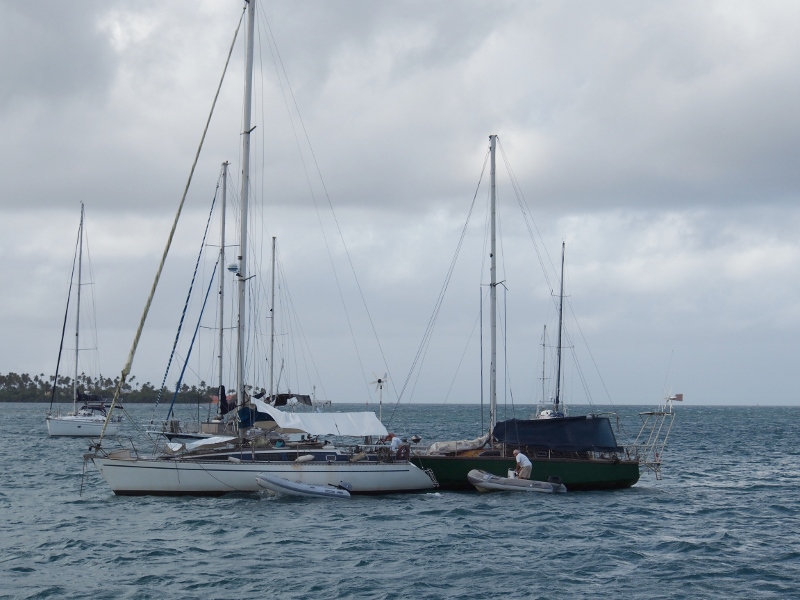
A good ending to what could have been tragic, a near miss that could have been two smashed up boats. It could easily have been our boat that was dragging whilst we were out on one of our numerous trips, or we could have been the boat downwind that a dragging boat slams into. When you’re on board you at least have the power to move the boat, but what if it drags while we’re on shore, or when we’re asleep? David laughs, but this is the first time I’ve been responsible for a mobile home. I guess I just have to get used to it, but it is quite different from a house, anyway.
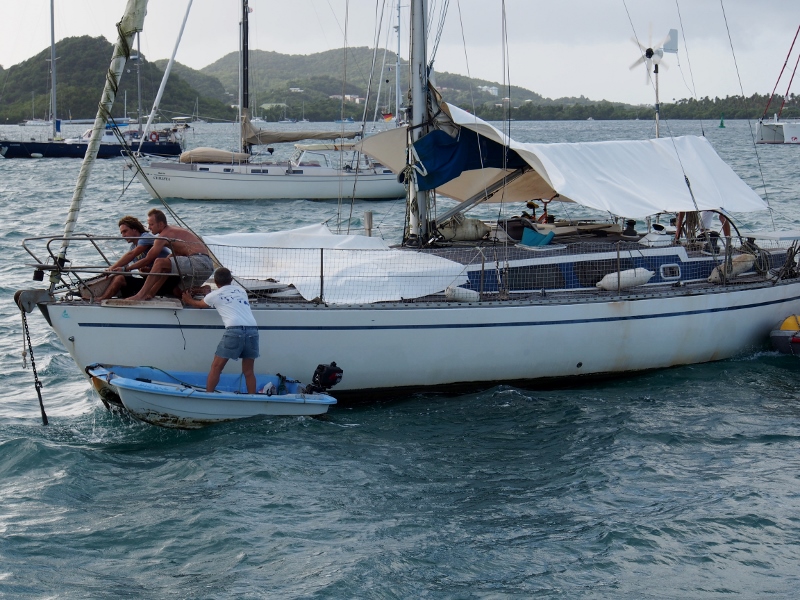
It makes me paranoid, and every time we set anchor I spend a long while after checking that we are not dragging. And then checking again when a strong gust of wind passes over us. It’s becoming a standing joke – we arrive in a new place, set the anchor, David goes in the dinghy to check us in with customs, and the kids and I start panicking about dragging. Bob, the drag queen. Invariably when he gets back to the boat, I have the engine running and the children are jumping around excitedly shouting ‘we’re dragging, Daddy, we’re dragging’. We normally aren’t, but as you swing around a mooring the angles can make you seem much further from other boats one minute than the next. Regardless, I’m always relieved when David comes back, because it’s not easy for me to get the anchor up on my own (you need one person at the back to drive the boat, and one on deck getting the anchor and chain up), and I can’t trust the kids to hold the boat or pack the anchor chain. So when there is no other crew on board, my only option might be to keep my position and wait patiently until David comes back.
That same night, we anchored in another spot, and set the anchor alarm to go off if we moved more than 60 m from our spot. It is hard to know what distance to set the alarm to, as the boat will naturally swing around on an anchorage as the wind and current changes. The following morning, as we were leaving, we could see that we had indeed dragged about 30 or so m – not enough to hit the boat behind us, but enough to leave me unsettled. Whenever we anchor now, the kids and I always dive on the anchor and mark the spot, and then check again half an hour later – that passes the time until David is back from customs, and at least we have something verifiable to report, rather than just guesstimates or rough bearings. Just so he’ll take us seriously, that’s all.
 SV Bob The Cat