
We’re leaving Martinique, to spend a couple of weeks in St. Vincent and the Grenadines. So it is au revoir to the town of Marin, at the southern end of the island, where we’ve been based for the last two weeks. Being a large yachting centre, Marin is a good place to get work done and buy spare parts, but we’re looking forward to seeing some other places.
Martinique is lovely, though. Like many of the islands, it is perched on an underwater mountainous ridge which forms an arc around 900 km long. The highest point of the island is Mount Pelee in the north, a volcano that last erupted in 1902 where it killed 30,000 people, razed the then capital city St. Pierre to the ground, and caused general economic mayhem. The steep hill sides are covered in lush green tropical vegetation and most of the coastline is rocky, with little sandy bays dotted here and there. Like all islands here it has a windward (Atlantic) side, and a leeward (Caribbean Sea) side; we’ve only explored the leeward side so far.
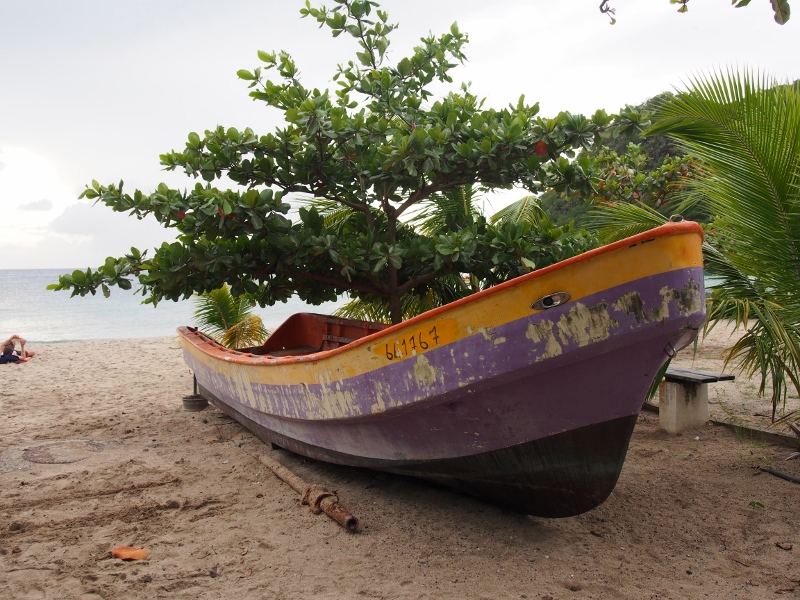
The island is thought to have settled by humans for a long time, with waves of people reaching the Antilles from South America. Remains (including pottery) have been found from a people called the Arawaks who fished as well as cultivated the land. Their peaceful existence was interrupted around the 12th century, when the bloodthirsty Caribs arrived from South America, killing and eating most of the Arawaks (the origin of the word ‘cannibal’ is thought to be the Indian name for Caribs: Kalinas).

Christopher Columbus came to Martinique in 1502, and named it Madinina, ‘Island of Flowers’, a name thought to be of Carib origin. However, because of the hostile Caribs and their pet (fer-de-lance) snakes the island got a bad reputation and was not settled by Europeans until 1635 when a couple of Frenchmen founded Fort St Pierre. Subsequently, the island was conquered by the English and retaken by the French a couple of times, but all the fighting stopped in 1814, and the island is now a French Overseas Department.

When sugar cane plantations took off at the end of the 17th century, African slaves were brought to the island, and of the current population of just over 400,000, 90% is mixed race of African origin. There are only about 4000 descendants of old Carib roots left. The two languages are French and French Creole.

Being in a French place has numerous advantages, most of them to do with food. Wonderful baguettes, pain au chocolats, croissants on sale everywhere. Great coffee, and great quality wine, much cheaper than in New Zealand. Alcohol is exceptionally cheap here, the cheapest by far being the 3 litre rhum foilpacks for only 15 euro. French cheeses: unpasteurised camemberts, nutty emmentales, sweet fromage frais. Jambon crue and about 50 varieties of salami in every shop; even foie gras is for sale in the supermarket.

Despite all the cheap unhealthy food, people look fantastic. On one of our numerous shopping missions, we went to a mall in the capital Fort de France. Never have I seen so many stylish women. Slim and tall, all shades from bronze to black, teetering about on incredibly high stilettoes looking like they’ve just stepped out of Vogue. A stark contrast to shopping malls in New Zealand which tend to be the gathering places for overweight poorly dressed people.

And then the annoying bits. The French can be incredibly rude; the concept of service seems completely alien to most of the marina shop keepers. When you walk into a store you are greeted with an irritated sigh as the owner puts out his cigarette out front and reluctantly follows you in. It feels like we are ruining their day by choosing to buy something in their shop, like they’re doing us a great favour by receiving our money. The born and bred locals are friendly and will stop and help you find your way in the street, it is only the French who have recently made their life here who seem afflicted – but being in a marina town, those are the people we meet. Not that I can speak, being Danish – I still cringe for my lovely Mexican friend Nuria: we met at the University of Stirling from where she got a scholarship to go to Roskilde University for three months. She came back humiliated and astonished by the unfriendliness of Danes . I guess I have just forgotten the European way because Kiwis are so friendly.

Above all, the French here hate Americans, and often if we get treated badly it’s because they hear us speak English and assume we’re from the US. Which seems a bit unfair as Americans generally love the French and treat foreigners that visit the US with respect, enthusiasm and interest. The charter companies tell us that the cool French reception is the reason there are so few American tourists here – faced with unfriendly Frenchies, they simply go elsewhere for their holiday. A great shame for the locals, who could earn good money from more tourism.
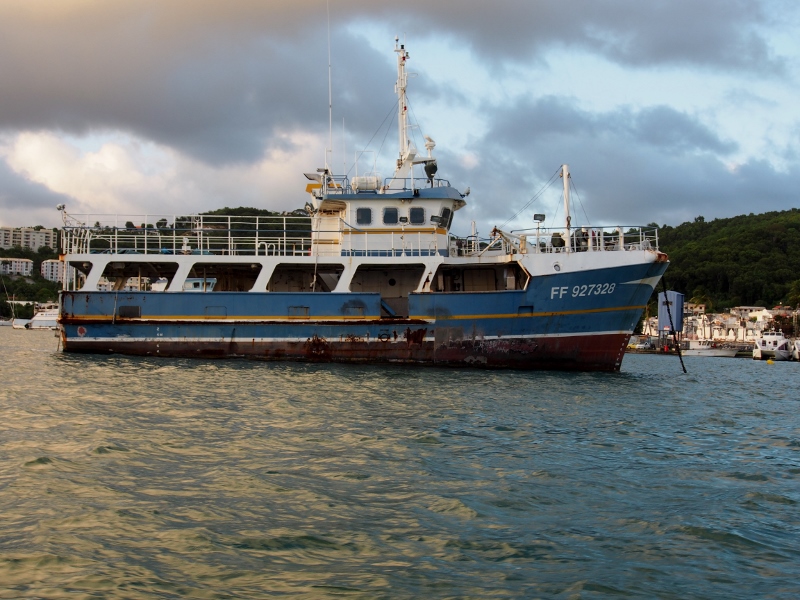
The upside is that we get plenty of practice for our French, which is great. In fact, the whole family is turning trilingual; guys coming to the boat swear freely and the children now happily chant ‘Merde! Putain!’ whenever something goes wrong. In my quest for better service, I have made a point out of speaking Danish to the kids when we’re out and about, to show the world we’re European. Although that did backfire when the local chandlery got us a Dutch flag rather than the New Zealand one we ordered. I think the guy in the shop assumed that as Zeeland was somewhere in Holland we meant a Dutch flag. ‘New Zealand, Holland, what’s the difference?’ he shrugged when we politely pointed out it was the wrong flag.

It is also strange to stock up in another language. I’m trying to decipher what is actually in the cleaning products, the food, and even the fire extinguisher puzzles me (it says that it contains Eau Pulverisee: pulverised water ?!?). Sunblock is only available in the pharmacy, and there just in tiny high-end bottles, when what I really want is an industrial size container with a pump dispenser, like you get in New Zealand.
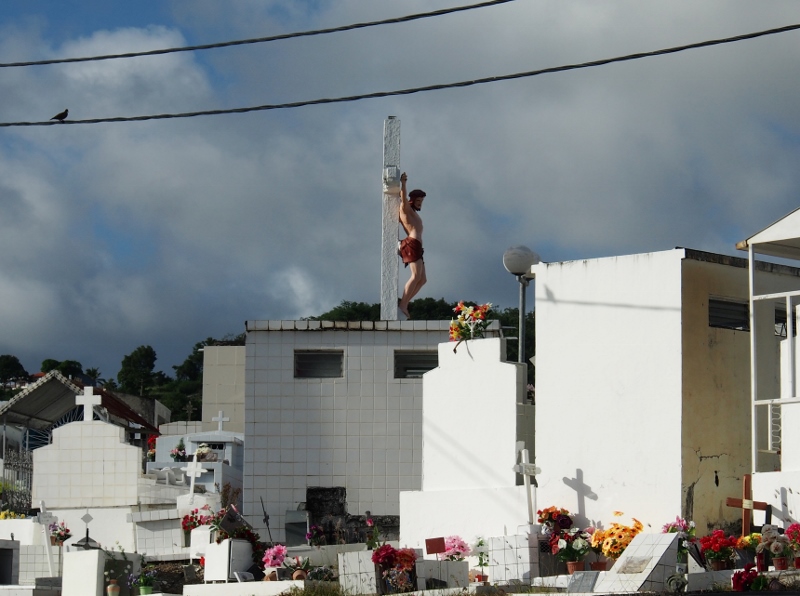 But it is so beautiful. Little towns with big churches and beautiful narrow streets. Amazing graveyards packed full of shiny white shrines decorated with bright flowers, and even a crucified Jesus. Colourful buildings dotted on the hillsides. Incredible vegetation – palm trees, cactus trees, frangipani and other tropical flowers in abundance dotting the landscape with sharp pinks and purples. Weary cows resting alongside the road, just along from the sugar cane fields. Coconut trees lining the back of the white beaches. Crabs everywhere, holes of all sizes lining the beach and beyond, their inhabitants scurrying away when our shadows fall on them. Lush mangroves reclaiming the sea. Underwater landscape like you wouldn’t believe – corals, seagrass, fish, colourful life everywhere.

It’s been 23 years or so ago since I was last here, but it is still just as beautiful. We’ll depart tomorrow, but will come back before we leave the Caribbean, and have a look along that windward coast.
 SV Bob The Cat