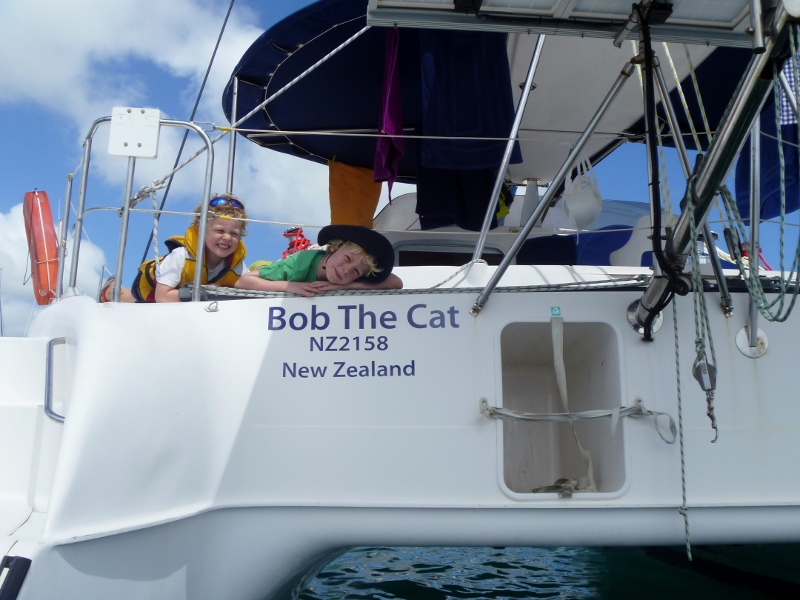
I should probably describe the boat a bit. She is a 46 foot Fontaine Pajot Bahia catamaran from 2004 – the charter version of the boat, which means lots of berths and heads (toilets), and in her former life as Alize V, she spent most of her life in a charter fleet. Each hull contains two double cabins with ensuite toilet / shower, and two additional single berths, one in the corridor and one in the far forward cabin. So if we wanted to we could sleep 12 people, although the forward cabin is only really suitable for a person of slight build with no tendencies towards claustrophobia.
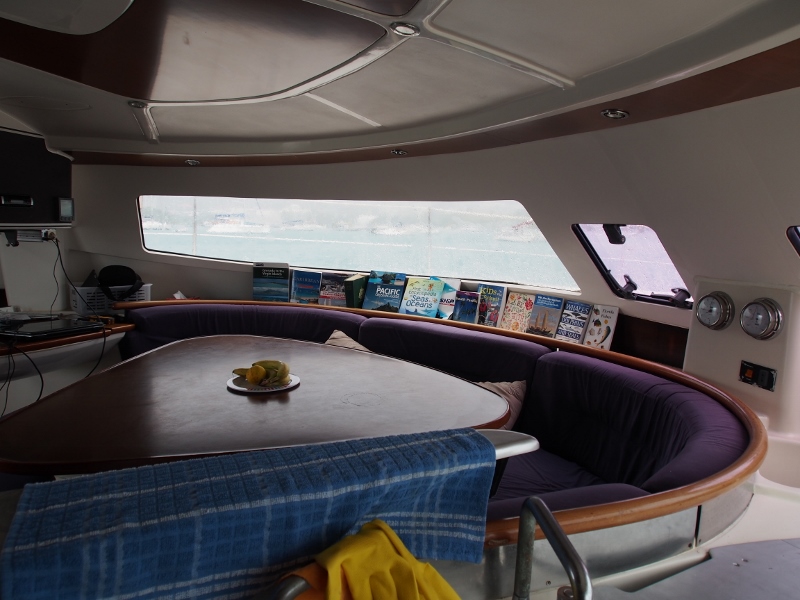
Up above between the two hulls is the saloon, with a chart table, a galley (kitchen) and a sitting area large enough to seat 10 people comfortably around a big triangular table. The galley is small, with two sinks, a freshwater and a saltwater tap, a three stove gas cook top, a small gas oven, and a large fridge/freezer. All compacted into an area of about 2 m2, so there is only room for one person at a time. The top of the fridge doubles as a small bench top, the lid of the garbage bin as a cutting board. Whilst frustratingly tiny, it does have a wonderful view out over the deck and the water beyond.

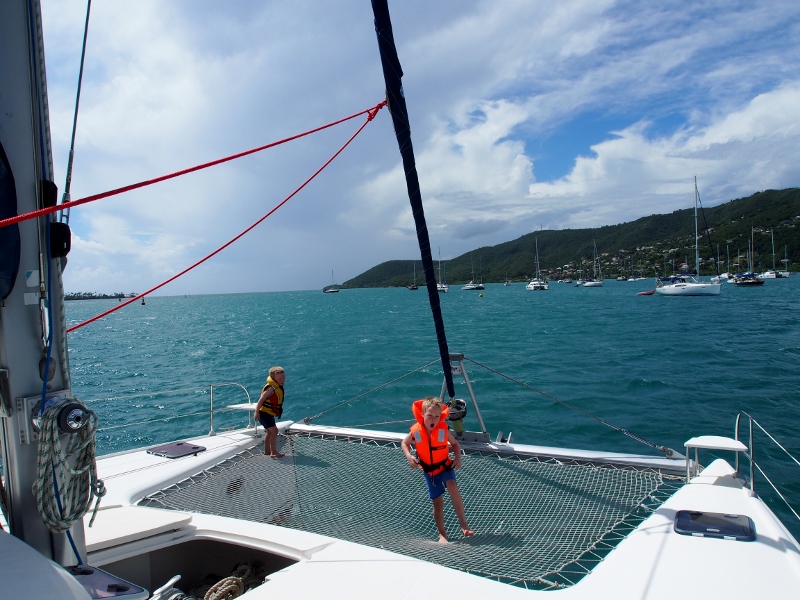
The saloon opens straight out to the cockpit, where there is an outdoor table and seating, as well as the steering wheel and instruments. There is access to the engines as well, with one engine locker on each side. Storage lockers are under and at the back of the cockpit deck. To get on deck from the cockpit you have to step up about two feet, so there is little danger of the kids accidentally falling out. At the bow (front) of the boat a trampoline is strung between the two hulls.

We got a catamaran because they are spacious and comfortable, and we’ve found it a great boat. Plenty of space to sleep us and visitors, lots of storage, and a trampoline to entertain the kids when they feel jumpy. Easy access to the water, with steps at the back of each hull leading down to the water’s edge, and a flip down ladder on one side for climbing in and out. When not in use, the dinghy is suspended at the back between the two hulls, under a large solar panel.
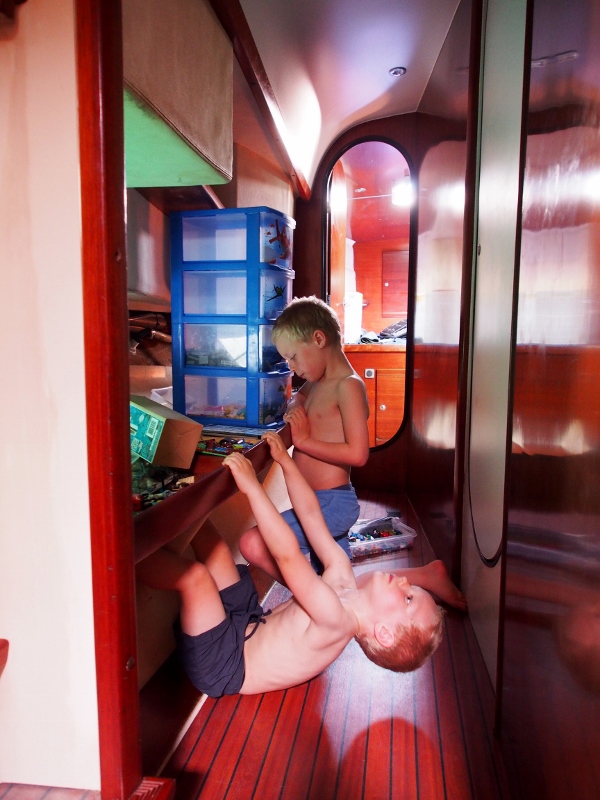
Another upside to a catamaran is how comfortable they are when sailing. Because they sit flat in the water rather than lean over like a keel boat, the kids can play with lego, draw or write as we’re sailing. It also means that we don’t have to be as careful to stow everything when we take off as you would be on a monohull; things tend to stay in their place even when we’re in a bit of swell, so we don’t have to tie everything down, and we can easily boil the kettle even when sailing upwind. The 180 degree view out front from the saloon helps minimise seasickness when inside, as you can clearly see a large stretch of horizon.
Each cabin and each toilet has an overhead hatch, as well as one or more side hatches, which helps keep the air flow when at anchorage. The larger ones you can crawl in and out of, and the kids spend hours playing hide and seek, jumping in and out of hatches, pretending to be on a spaceship travelling at hyperspeed through a watery universe.
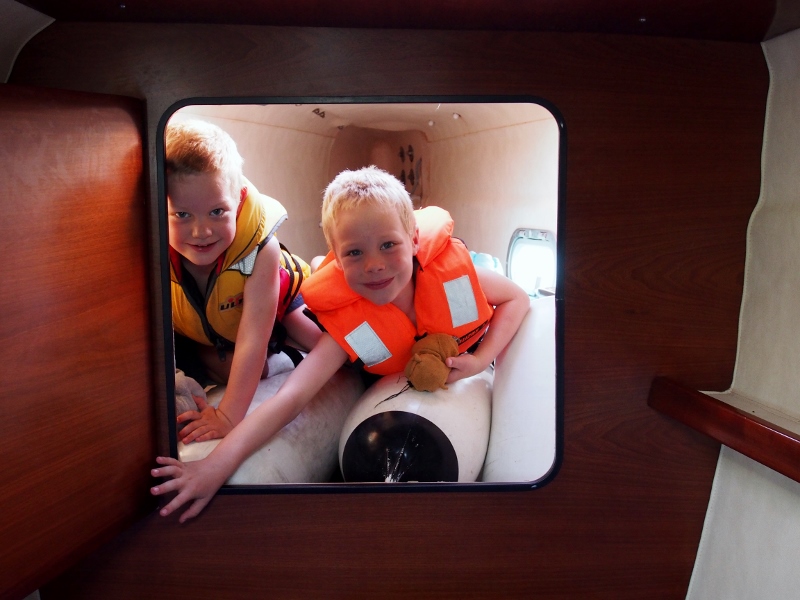
Storage is everywhere, with tins, beans, UHT milk and flour below bunks and seating. We store kitegear in one forward cabin, and fenders in the other. We inhabit the port hull, and the starboard one is presently filled up with Lego and tools, but will be awaiting guests keenly once tidied. For the moment everything is a mess most of the time, with tools, books and lego cluttered around, and towels and swimwear streaming in the wind from the cockpit.
In essence she is like a big, slightly damp caravan on water, somewhat battered but in good repair. Locker door handles are rusty, the cupboards bear permanent marks from pots stored years ago. The dark blue cushions are bleached by the merciless sun, the bathroom mirrors streaked in places where the backing has worn away. Here and there the gel coat is chipped, and we’ve had to replace several ropes that had worn through dangerously. David has been working ceaselessly fixing bits and bobs, from a broken toilet to a leaking hatch, replacing a set of worn out steering lines, affixing a ceiling that was dragging down. Where we need it, we get outside help – a new sailbag is being made for us, the broken VHF is being fixed, a fresh trampoline on order.
Sailing wise, she is not a high performer, although we’ve been pleasantly surprised at her speed. The sails were brand new when we bought her, and we’ve been easily cruising at 7 to 8 knots. This will be important on passages between islands (the distances here in the Caribbean are quite short, but in the Pacific they’ll be much greater) where gain in speed will cut the travel time, possibly by days. A typical catamaran, she doesn’t sail too well upwind or downwind: she is reasonably fast, but can’t point into the wind, or away from it.
As soon as we get the VHF sorted, we’ll head away for a longer trip, and test her out some more. I’m looking forward – the small forays we’ve done so far have whetted our appetite for more.
 SV Bob The Cat